Xi asked for a human still in charge. Trump had already named the DOJ.
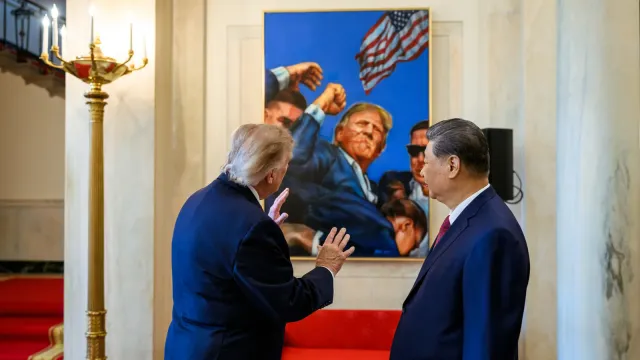
At Thursday’s White House arrival, Xi said the United States and China must keep AI under human control. Hours earlier Trump said Super Intelligence would be a big topic and that he wants to leave it exactly where it is, with the Justice Department as the guardrail — and he assigned that freeze to Beijing. The lab chiefs had asked the rivals to cooperate. Tuesday is a meeting with the speaker.
WASHINGTON — September 25, 2026
The disagreement was on the record before the doors closed. On Thursday, during the arrival for Xi Jinping’s state visit, the Chinese president told Donald Trump that China and the United States are both leading nations in artificial intelligence, and that they have “both the capability and responsibility to develop and manage AI for good, and ensure that the development of AI is always under human control and serves the well-being of the people.” Hours earlier, on Truth Social, Trump had already described the conversation he wanted. Super Intelligence — the name he has been forcing onto the technology — would be “a big topic of discussion,” and he wanted to “leave it exactly where it is.” He said that was China’s position too. “Our guardrail is the DOJ!”
One sentence puts a human over the system. The other names a prosecutor, announces a freeze, and then hands the freeze to the guest.
A department that can indict is a legal system. It is not a hand on the training run. Xi asked for the hand. The morning post had already said the run can stay where it is.
The sentence at the arrival
Xi’s line is not a wire’s paraphrase. The Chinese foreign ministry published the arrival remarks, and Xinhua published them as a full text. The AI paragraph sits inside a longer argument that the two countries’ interests are intertwined, that their cooperation will not solve every problem, and that many problems will not be solved without it. Then the technology. Yonhap, ABC News, and The Independent all came back with the same shape: capability, responsibility, for good, always under human control, the well-being of the people. The Washington Post’s arrival live file on Thursday afternoon — the AP’s “The Latest” — put the same duty in shorter form: the two superpowers have a responsibility to ensure that humans always operate AI. The Washington Post’s Friday story is built on that split — Trump rejecting demands for rules, Xi calling for human control — and on the order of the day. The chief executives had asked Washington to work with Beijing on the danger. The president opened summit morning by suggesting he was not interested. Xi is the one who brought the duty into the ceremony.
He did not stop at stewardship. In the same address, in the consecutive translation ABC News reported from the Grand Foyer, Xi said competition need not be avoided, but it should be healthy and kept within bounds: “a race of catching up with one another, not a wrestle in which one either wins or loses.” That is an argument with a podium this desk already filed. On Tuesday, at the General Assembly, Trump said whoever wins superintelligence wins. Thursday’s guest described a race that is not supposed to end with a body on the mat.
Trump’s ceremony remarks did name the subject. Security, technology, and super intelligence would be discussed, he said, and the decisions “can promote peace and prosperity for decades and decades to come.” He did not, in that speech, repeat the morning instruction to leave the technology where it is, and he did not mention the Justice Department. The South Lawn spray, in the Reuters takeaways The Independent published Friday, was smaller. Asked about the talks, he talked about granite. “He loves good granite,” Trump said of Xi. “Great meeting.” By the state dinner, ABC reported, the president’s toast did not mention artificial intelligence at all. A president can put Super Intelligence on a foyer agenda and decline to discuss it over the silver. The record is which sentence he was willing to put next to Xi’s.
Xinhua’s account of the closed talks does not collapse the two positions either. Xi, the agency reported, said China and the United States compete in AI and have even more reasons to cooperate. They should use their respective strengths rather than guard against each other. They can keep a dialogue, exchange views on risks and benefits, and work to prevent misuse and abuse. They should maintain human control, a people-centered approach, and the principle of using AI for good, so that the technology serves human progress. Dialogue and a warning against misuse are a request for a channel. A channel is not a brake. It is also not a prosecutor.
The post that got there first
The morning text is short enough to keep, because the compression is the policy. “A big day with President Xi of China,” Trump wrote. “Super Intelligence (SI) will be a big topic of discussion, but I want to leave it exactly where it is. That is China’s position also. Our guardrail is the DOJ!” The Hill, Reuters, Yonhap, and The Independent all carried that post on Thursday. “Leave it exactly where it is” refuses a new rule, a pause, and a joint instrument, and it does so before the meeting where those things could have been argued. Calling the Justice Department the guardrail tells you which kind of control he will admit. A prosecutor acts after a statute already on the books has been broken. The department does not read a training log because a capability eval looks wrong. It does not sit in the room when two labs decide the next model is worth the risk. Reuters noted that last week he had already said the United States has guardrails in place to regulate and prosecute AI companies. Thursday’s post gave that claim a street address.
The other half of the post is the attribution, and it does not survive the guest’s own text. “That is China’s position also.” Xi did not say he wants the technology left where it is. He said the two governments have a responsibility to manage it and to keep a human over it. Yonhap’s overnight file is the plain version: apparent differences on guardrails, even while both leaders talked about cooperation. Trump has cast the fear as a hoax. Xi used the welcome to say development should stay under human control. You can believe Beijing’s duty-language is diplomatic and its labs are in the race anyway. You still cannot staple the guest’s sentence onto the host’s freeze and call them one position. The Washington Post adds a July speech, at China’s major annual AI conference, in which Xi said oversight should be developed to “forestall loss of control.” Reuters, filing next week’s meeting, put the policy comparison in a single paragraph: Trump argues the United States does not need new AI-specific rules; China has imposed rules on algorithms and training data, including a requirement that AI-generated content be labeled. A labeling rule is not a loss-of-control regime. It is evidence that “China’s position” is not a blank page.
What the chiefs had already asked
None of Thursday repealed Tuesday. From the General Assembly, Trump said the United States “totally rejects any attempt to construct a globalist scheme to control” the technology, and that he would not stifle something he called bigger than the Industrial Revolution. This desk filed that rejection beside the Sanders bill. Thursday’s post is the same refusal, moved from a hall of governments to a bilateral the lab chiefs had spent Wednesday trying to make serious.
Their ask is already on this site, and it should not be re-litigated as if the Council had not sat. Sam Altman told the Security Council that countries which compete, and do not much like each other, have still come together “for shared interests and the collective good in the face of a powerful new technology,” and that “we believe this must be one of those times.” Dario Amodei, as Fortune reported from the same sitting, said no leader, no company, and no nation can manage this alone. That is a request for a shared instrument between rivals. Trump’s answer, posted before the welcome, was that the instrument is unnecessary and that Beijing agrees.
Hold the sizes. A chief executive asking two governments to cooperate is not a statute. A president declining the cooperation in public is not a finding that the systems are safe. The contrast is the news. The people who train the models asked the capitals to treat the danger as common. The capital that hosts the clusters said it likes the status quo, named its criminal-justice department, and informed the guest that the guest agrees.
There is a quieter object, and it should not be inflated into the control scheme Trump says he rejects. Ahead of the summit, CNN reported, Treasury Secretary Scott Bessent and Vice Premier He Lifeng discussed a U.S. proposal for an AI dialogue and a notification system covering incidents that rise to national security. Bessent’s point at the end of those talks was transparency: moving from opaque to more visibility between the number one and number two powers in AI. He said the Chinese response was not clear. Yonhap, overnight, described the same idea as a reported proposal. A phone that rings after something has already gone wrong is closer to what the labs asked for than a Truth Social freeze is. It is still a phone. It does not read the run, and it does not become “always under human control” until someone can say what the human is allowed to stop.
Tuesday is a room, not a rule
The state dinner put some of the people who asked for that cooperation inside the building. ABC News, citing the White House and a source familiar, reported a guest list scheduled to include Sundar Pichai, Sam Altman, Jensen Huang, Elon Musk, and Mark Zuckerberg, among others. The Reuters takeaways had Pichai, Altman, and Huang expected. A chair at a dinner is not a look at a training run. Trump’s dinner remarks, ABC reported, did not mention the technology. Xi, in the East Room, talked about responsible major countries. The chiefs were close enough to hear a toast. They were not handed a veto.
What they may get is a different room, four days later. Reuters reported late Thursday, citing a source familiar with the plan, that Trump, House Speaker Mike Johnson, and technology chief executives will meet on artificial intelligence on September 29. Axios had it first. Further details were not available, and the wire did not produce a list of who will be in the chairs. ABC, citing multiple sources, matched the date and carried a sentence Johnson gave reporters last week. There would be a deliberate discussion of the companies’ responsibility to maintain safety, “and what role, if any, the government has to play in that.” If any is the clause. It describes a government that has spent the week rejecting schemes. It is not yet a decision.
The day’s other announced object should stay in its lane. Reuters reported that Bessent said the two sides agreed to extend their trade truce by two months, past a November expiry and into the next round of arguments over tariffs, farm purchases, rare earths, and technology restrictions. A short truce is a calendar. It is not an AI policy, and it does not tell you which of Thursday’s two sentences on the technology anyone intends to keep.
A Justice Department can matter. Fraud, monopoly, a criminal misuse, a lab that lies to an agency — those are cases a prosecutor can bring when a statute reaches them and someone chooses to file. Pretending criminal law is decorative because it is not a pause is how this argument becomes a poster. The limit is the one the sentence admits. A guardrail that begins at indictment begins after the conduct. The fear the chiefs put in the Council, and the duty Xi put in a welcome, is about a system that gets ahead of the people who are supposed to be able to stop it. You do not indict a capability into staying put.
Xi’s sentence can be read just as coldly. “Always under human control,” said by a state that does not publish its training logs, is a slogan until it has an inspector. Beijing can say the words in a foyer and still run. Washington can hear them and still ship. The useful fact is that the words were said in public, next to a president who had pre-rejected a global scheme to control the technology, and that his attempt to conscript Beijing into the freeze did not survive the guest’s text. Xinhua did not publish “leave it where it is.” It published cooperation, a warning against misuse, and human control. Those are Beijing’s sentences. They are allowed to be self-serving. They are not Trump’s post.
This newsroom has spent the week on the same missing object. A supervisor can look at a run and make it stop. Sanders wrote a prison term this Congress is unlikely to pass. The Council heard a promise to slow down from people who still measure the slowdown themselves. Twenty-two countries asked for a human still directing the systems, and neither of these two capitals signed. On Thursday the human-control sentence was spoken at the White House anyway, by the leader of the country that also stayed off that paper, to the president who called that kind of ask a globalist scheme. The answer had been posted before the ceremony. Leave it where it is. The guardrail is the Justice Department. China’s position, he said, is the same.
Read the two transcripts against each other. They do not match. The clusters will not adjourn while Washington decides whether the mismatch matters. On Tuesday the speaker and the chiefs get a room, and the question already sitting in Johnson’s sentence is whether the government has a role at all. A prosecutor is a role. It is the role Trump named. It is not the role Xi described at the arrival, and it is not the shared instrument the people who build the systems asked the Security Council to invent. If September 29 produces another account of where things already are, the week will have ended where Thursday’s post began: a freeze standing in for a safeguard, and a human still missing from the only sentence that asked for one.